


Two Museums, One Story
The Louvre and the Musée d’Orsay sit a 15-minute walk from each other along the Seine, and together they tell the story of Western art from ancient civilisation to the early 20th century. The Louvre covers everything up to roughly 1848 — ancient Egyptian, Greek, and Roman art, medieval and Renaissance painting, and the grand tradition of European art through Delacroix and Ingres. The Musée d’Orsay picks up from there — Impressionism, Post-Impressionism, and the revolutionary movements that dismantled the academic tradition the Louvre enshrines.
A combined Louvre and Musée d’Orsay tour gives you this full arc in a single day, with a guide who connects the dots between what you see in each museum. The transition from the Louvre’s formal, monumental paintings to the Musée d’Orsay’s light-drenched Impressionist galleries is one of the most dramatic shifts in art history — and walking between the two museums along the Seine, seeing it happen chronologically, makes that revolution tangible in a way that visiting either museum in isolation can’t achieve.
What You’ll See at Each Museum
At the Louvre, a combined tour focuses on the works that set the stage for what the Impressionists reacted against — and, equally important, what they built upon. The Grande Galerie’s Italian masters show you how composition, colour, and perspective were refined over centuries. The French painting galleries take you through the Neoclassical and Romantic movements — David’s rigid political canvases, Delacroix’s emotional and colourful ones — that defined the academic standard of the 19th century. The guide builds the foundation: this is what “great art” meant in the mid-1800s, and this is the tradition that a group of young painters was about to demolish.
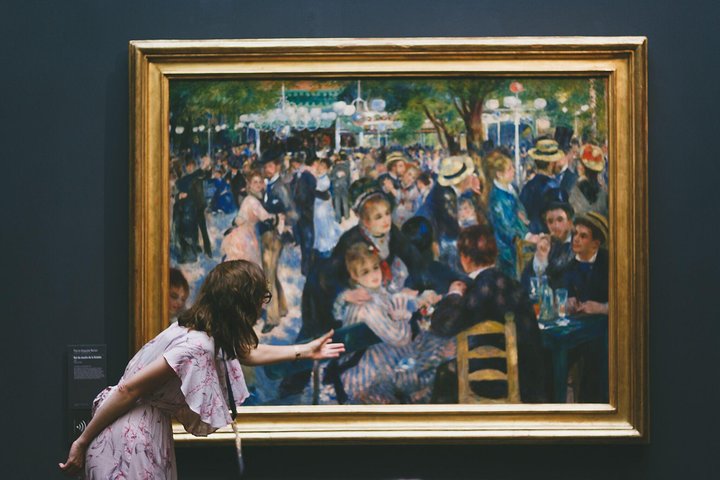
At the Musée d’Orsay, you see the demolition — and what replaced it. The museum’s fifth floor (the top level, under the former railway station’s glass roof) houses the Impressionist and Post-Impressionist collection that is, for many visitors, the most immediately beautiful collection of paintings in Paris. Monet’s water lilies and cathedrals, Renoir’s dancing couples, Degas’s ballet dancers, Cézanne’s landscapes, Van Gogh’s bedroom and self-portraits, Gauguin’s Tahitian scenes. The guide connects these works back to what you saw at the Louvre — showing you how Monet’s brushwork broke from the polished finish of the academic painters, how Cézanne’s fragmented landscapes opened the door to Cubism, how the Impressionists’ decision to paint outdoors and capture fleeting light was a radical act in a culture that measured art by its adherence to centuries-old studio traditions.
How Combined Tours Are Structured
Most Louvre and Orsay combination tours run as a full-day experience, typically 5–7 hours with a break between museums.
The standard format begins at the Louvre in the morning (2–3 hours), breaks for lunch (usually 1–1.5 hours, at a guide-recommended restaurant or independently), and resumes at the Musée d’Orsay in the afternoon (1.5–2.5 hours). The Louvre comes first because it provides the historical foundation — you understand what came before, which makes the Impressionist revolution at the Orsay dramatically more meaningful.
The reverse format (Orsay first, Louvre second) is less common but suits visitors who are more excited about Impressionism — starting with the works they’re most eager to see while energy is highest, then contextualising them with the Louvre’s older collections. This format works intellectually but sacrifices the chronological impact.
The walk between museums is itself part of the experience. The Louvre and Musée d’Orsay sit on opposite banks of the Seine, connected by the Passerelle Léopold-Sédar-Senghor footbridge. The 15-minute walk crosses the river with views of both museums, the Tuileries Garden, and the Eiffel Tower — and gives your guide an opportunity to bridge the historical gap between what you’ve just seen and what you’re about to see.
Is the Combined Tour Worth It?
The combined tour is ideal for visitors who want to understand art history as a connected narrative rather than a collection of isolated masterpieces. If your reaction to a painting is “that’s beautiful” and you want to know why — what the artist was trying to do, what tradition they were working within or rebelling against, and what came after them — the combined format delivers this in a way that separate visits to each museum can’t match.
It’s also a practical solution for visitors with limited time in Paris. Covering both museums in a single guided day is significantly more efficient than visiting each independently on separate days — the guide handles all skip-the-line entry, routing, and museum navigation, and the narrative thread means no time is wasted on orientation or figuring out what to see.
The trade-off is stamina. A 5–7 hour art tour across two museums is a substantial commitment. By the Musée d’Orsay’s third floor, even engaged visitors can experience museum fatigue. The lunch break is essential — use it for genuine rest, not just food — and the best guides pace the afternoon session more gently than the morning, recognising that their group’s absorption capacity is lower.
Practical Tips
Wear your most comfortable shoes. A combined tour covers 8–12 kilometres of gallery walking on hard floors across two museums. This is not a metaphor for a lot of walking — it is genuinely a lot of walking. Foot comfort is the single most important practical consideration for a full-day museum tour.
Use the lunch break wisely. Sit down. Rest your feet. Eat a proper meal rather than grabbing a sandwich on the go. The Tuileries Garden between the two museums has benches if the weather is good. The afternoon session is better if you arrive at the Orsay rested rather than having power-walked through lunch.
Morning at the Louvre is particularly important. The Louvre is more crowded and more physically demanding than the Orsay. Doing it first, when your energy is highest and the morning galleries are quieter, produces a better experience at both museums.
The Musée d’Orsay is closed on Mondays. The Louvre is closed on Tuesdays. A combined tour must therefore run on Wednesday, Thursday, Friday, Saturday, or Sunday — with Wednesday and Friday offering the bonus of the Louvre’s extended evening hours if the format allows.
Frequently Asked Questions
Can I do both museums in one day without a guided tour?
Yes, but the guided format adds substantial value. Without a guide, you’re navigating two enormous museums independently, selecting which works to focus on from thousands of options, and providing your own art-historical context. It’s entirely possible but considerably more tiring and less rewarding than having a guide manage the route, the pacing, and the narrative.
Is this too much museum for one day?
It depends on your interest level and stamina. For visitors who genuinely enjoy art, a well-guided combined tour is deeply satisfying — tiring but rewarding. For visitors whose museum tolerance is moderate, a half-day at either museum might be the better choice. If you’re unsure, the Louvre alone is the priority for a first Paris visit; add the Orsay if you have a second day or strong interest in Impressionism.
Do combined tours include skip-the-line at both museums?
All reputable combined tours include timed-entry tickets for both the Louvre and the Musée d’Orsay. This is essential — queuing at both museums independently could cost you 2+ hours of your day.
What’s the best day of the week for a combined tour?
Thursday is often ideal — both museums are open, and Thursday tends to be one of the quieter weekdays at both venues. Wednesday and Friday are also good, with the added benefit of the Louvre’s extended evening hours. Weekends are busier at both museums, particularly Saturday.